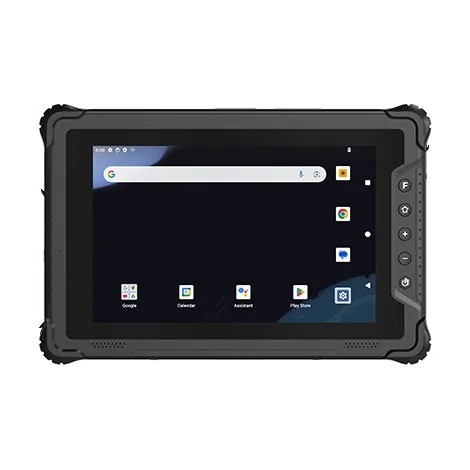
UHF RFID is often sold as a barcode replacement. It is not. A barcode answers "what is this one item, right here, aimed at". RFID answers "what is in this space, right now". That difference decides whether a handheld RFID reader earns its cost, and it decides which tag and reader you need. This note walks eight industries where handheld RFID is growing, and for each one names the asset, the tag problem, the read distance that matters and the device requirement. It is written for operations and IT people evaluating a pilot, not for a tag salesman.
The three laws of handheld RFID
Before the industries, three rules that explain most failed pilots.
- The tag is the project. The reader is a commodity. If the tag does not survive the environment and stay attached, no reader will save it. Budget for tag trials, not just a device.
- Metal and liquid change everything. UHF radio reflects off metal and is absorbed by water and people. A tag that reads at 10 m in air may read at 30 cm on a steel drum or inside a liquid-filled tote. On-metal tags and careful placement are not optional.
- Read distance is a range, not a number. A "20 m" reader means 20 m on an ideal tag in ideal conditions. In a real aisle, with racking and people, plan for a fraction of it and test on site.
A rough device map
| Requirement | What to look for | Typical model class |
|---|---|---|
| Many assets, medium range | 1–3 m handheld, fast inventory sweep | Compact UHF handheld |
| Pallet / carton at distance | 10–20 m class, circular-polarised antenna | Long-range UHF handheld |
| Outdoor, harsh, all-day | IP67, wide temperature, hot-swap battery | Rugged UHF handheld |
| Fixed gate + handheld pair | Reader with Wi-Fi/4G backhaul, batch mode | Handheld + fixed portal |
Everything below assumes a handheld reader unless stated otherwise.
1. Healthcare and hospitals
- The asset: infusion pumps, wheelchairs, beds, instrument trays, linen, high-value consumables.
- The tag problem: metal equipment and liquid containers; sterilisation cycles (autoclave heat and moisture) destroy ordinary labels. Use sterilisation-tolerant tags and on-metal tags, and test after 50 cycles, not one.
- Read distance: mostly 0.5–3 m. You are counting a room, not a yard.
- The device: quiet, lightweight, easy to clean, IP65+, and a screen that a nurse can read in a corridor. Handheld RFID also speeds tray reconciliation before and after procedures.
- The win: asset utilisation. Hospitals routinely lose 20–30% of movable equipment to "somewhere else in the building". RFID inventory turns a half-day search into a ten-minute sweep.
2. Power, utilities and substations
- The asset: transformers, meters, cable drums, tools, safety equipment, spares in depot.
- The tag problem: high metal content and outdoor UV. On-metal tags rated for sun and rain; avoid adhesive labels on painted steel that chalks in a year.
- Read distance: 1–5 m in depot; longer for line-side asset checks.
- The device: IP67, wide temperature, glove-friendly, long battery, and certified for any classified area on site (see the explosion-proof note — rugged is not the same as Ex-certified).
- The win: audit and compliance. Regulated asset registers need periodic proof of presence and condition; RFID plus a photo on the same device produces the record in one pass.
3. Energy: solar, wind and oil & gas
- The asset: PV modules and pallets, turbine components, pipe spools, valves, PPE, contractor tools.
- The tag problem: PV glass and aluminium frames, offshore salt spray, remote sites with no network. Choose tags for UV and salt; choose a reader with batch/offline mode because the network is often absent.
- Read distance: 3–15 m depending on asset size; module pallets reward a long-range reader.
- The device: IP67, wide temperature, sunlight-readable screen, hot-swap batteries for a 12-hour shift, 4G/5G fallback.
- The win: receiving and commissioning. A PV pallet that is scanned once at goods-in and once at commissioning closes the "delivered but not installed" gap that plagues large solar builds.
4. Construction materials and building supplies
- The asset: rebar bundles, steel sections, cement bags/pallets, timber, MEP components, tool crib, returnable containers.
- The tag problem: dust, mud, impact and metal. Tags get hit, buried and washed. Use rugged encapsulated tags on metal, and accept that a percentage will be destroyed — design the process to tolerate it.
- Read distance: 1–8 m; on a yard, a long-range handheld saves walking.
- The device: IP67, drop-rated, bright screen for outdoor sun, and a body that survives being set down on gravel.
- The win: yard accuracy and shrinkage. Materials yards lose stock to misplacement; RFID location sweeps recover time and reduce re-ordering.
5. Mining and quarrying
- The asset: consumables (bits, bolts, fuel drums), PPE, equipment components, tagged personnel where permitted, ore/waste sampling trays.
- The tag problem: the harshest environment on this list — dust, vibration, water, temperature extremes, and long distances. Tags must be encapsulated and mechanically fixed, not stuck on.
- Read distance: 1–10 m; use RFID where line of sight is impossible.
- The device: the most rugged class available — IP67/IP68, wide temperature, high drop rating, long battery, and Ex certification where the mine requires it. This is not a place for a consumer tablet in a case.
- The win: consumable reconciliation and tool control. The value is in knowing what left the store and what came back, in an environment where paper does not survive.
6. Oil, gas and chemicals
- The asset: valves, flanges, pipe, drums, PPE, contractor equipment, cylinder tracking.
- The tag problem: metal, hazardous areas, and regulatory traceability. Tags must be certified for the area if they enter it; the reader must be Ex-rated for Zone 1/2 or Zone 21/22 as classified.
- Read distance: 1–5 m; keep reads short and deliberate in classified areas.
- The device: Ex-certified handheld (ATEX/IECEx or GB, per site), IP67, and a documented certificate you can hand to HSE. Verify the certificate against the issuing body — a "designed for hazardous areas" claim is not a certificate.
- The win: inspection and maintenance records. Tagged assets plus a device that captures reading, photo and timestamp close the inspection loop in the field.
7. Electronics and component manufacturing
- The asset: reels, trays, WIP carriers, finished-goods cartons, tools, fixtures.
- The tag problem: small items, dense metal, ESD-sensitive areas. Tags must be small and ESD-safe; reader power and antenna placement matter in dense racks.
- Read distance: 0.3–3 m; you are reading a shelf, not a yard.
- The device: compact handheld, fast read rate for reel-level inventory, Wi-Fi for MES integration, and a screen that shows a bin location clearly.
- The win: line-side replenishment and WIP visibility. Reel-level RFID removes the manual count that stalls a SMT line.
8. Agriculture and food processing
- The asset: crates and totes, pallets, livestock tags (where used), produce trays, cold-chain containers, farm equipment.
- The tag problem: moisture, mud, cold, wash-down and repeated handling. Tags must survive cleaning and freezing; on produce, condensation defeats many adhesives.
- Read distance: 1–8 m; reading a stack of crates benefits from a medium-to-long range reader.
- The device: IP67, wide temperature (including sub-zero cold stores), wash-down tolerant, and a battery that holds up in cold.
- The win: crate and tote circulation. Returnable containers are a hidden cost centre; RFID turns "where are our crates" into a count.
9. Retail and apparel (the mature case)
- The asset: item-level apparel, cartons, fixtures.
- The tag problem: mostly solved by the retail tag ecosystem; the challenge is reader ergonomics and speed on the floor.
- Read distance: 0.3–3 m for item-level counts.
- The device: compact UHF handheld that is comfortable for a full-store count and integrates with the POS/stock app.
- The win: stock accuracy and replenishment; the best-documented RFID ROI in the list, which is why it is the reference case for the others.
How to run a pilot that survives contact with reality
- Pick one asset class and one zone. Not "the warehouse" — "the steel racking in aisle 3" or "the infusion pumps on floor 2".
- Tag trial first. Tag 30–50 real assets, put them through a week of real handling, then check read rate. If the tag fails, stop and change the tag.
- Measure the baseline. Count or search time before RFID, in minutes, with a stopwatch. The business case needs a number, not an impression.
- Test the reader on site, in the real aisle, with the real tags, at the real distance, including metal and liquid nearby.
- Decide the integration before buying volume. Does the app take a keyboard-wedge scan, an SDK, or a batch file? That answer picks the reader model as much as the environment does.
Where a handheld stops and a fixed reader starts
A handheld is right for exception handling, audits, cycle counts and any task where a person is already walking. A fixed portal is right for a chokepoint that every asset passes — a dock door, a tunnel, a conveyor. Most programmes end up with both: fixed readers for the high-volume gate, handhelds for everything that does not fit a gate. Plan the pair from the start; retrofitting a handheld-only design into a dock gate is how pilots stall.
If you are evaluating a specific industry on this list, send the asset, the environment and the tag you intend to use. We will tell you which reader class fits and, more usefully, which tag problem will decide the pilot.