A long-range imager specified at 10 metres will not read the label on your top rack at 10 metres. It will read a label at 10 metres, under conditions the specification carefully defines and the sales conversation usually drops.
This is not a reason to distrust the number. It is a reason to test with your own label before you buy a fleet.
The four variables that decide the read
Every barcode read is a negotiation between four things, and range is the least interesting of them.
Module size (X-dimension). A barcode is made of modules — the smallest bars and spaces. A warehouse location label printed at 0.33 mm per module is roughly twice as readable at distance as one at 0.25 mm. Doubling the module size roughly doubles the working range for the same optics. If your labels were printed on a cheap thermal printer at minimum density, no scanner on the market will reach the top rack comfortably.
Print quality grade. Thermal transfer labels degrade. A label that graded A when installed three years ago in a dusty warehouse may now grade C or D: edges feathered, contrast down, a few bars merged. Long-range reading is far more sensitive to print quality than short-range reading, because the scanner is working with fewer pixels per module.
Contrast and substrate. A black bar on white paper at 4:1 contrast is easy. A black bar on a grey plastic tote, or a label under shrink wrap, is not. Reflective surfaces at distance produce specular highlights that blank out whole rows.
Angle. Range figures assume the scanner is roughly square-on to the label. Real aisle work involves reaching up at 30–45°, and every degree off-axis costs working distance.
What this means in numbers
Put crudely: working range scales with module size and inverse with the square of the field of view you need. A scanner that reads a 0.33 mm module label at 10 m will read a 0.25 mm module label at roughly 6–7 m under the same conditions, and considerably less if the label is angled or the lighting is bad.
For a rack 8.5 m high with a label at 8 m, that gap is the difference between a workflow that works and one that produces a scanner the team stops using after two weeks.
Test it in twenty minutes, not two weeks
You do not need a lab. You need a tape measure, your actual labels, and one unit.
- Take three labels from the rack — one new, one a year old, one from the worst-lit aisle.
- Stick them at your actual install height on a wall or a pillar.
- Stand at the distance the operator will actually stand, which is usually further than you think because of the racking itself.
- Try ten consecutive reads on each label, at the angle the operator will actually use.
- Count successes. Eight out of ten is workable. Six out of ten is a workflow that will generate support calls.
Do this before the purchase order, not after. It takes less time than reading the datasheet footnotes and it produces an answer that applies to your building.
When long range is the wrong answer
Sometimes the honest recommendation is not a long-range scanner. Consider these alternatives first:
Move the label. A location label at eye level on the rack upright is read by a standard engine at arm's length and costs nothing to relocate. If your racking allows it, this is almost always the cheapest fix.
Scan the pallet, not the location. If the pallet label is captured at goods-in, the put-away confirmation can be a location check performed by the WMS rather than a physical scan at height.
Fixed-mount scanner at the aisle end. For high-throughput aisles, a fixed reader at the mouth of the rack reads every tote as it passes and removes the manual scan entirely. Higher capex, lower labour, better accuracy.
Standard engine plus a reach tool. Cheap, and used by plenty of operations. It fails the moment the operator is on a moving order picker.
The long-range handheld earns its place when you genuinely need to identify a specific location or asset from the floor, repeatedly, across a fleet of vehicles. That is a real requirement in high-bay warehouses and it is worth paying for. It is a waste of money if the requirement came from one bad aisle.
The device side
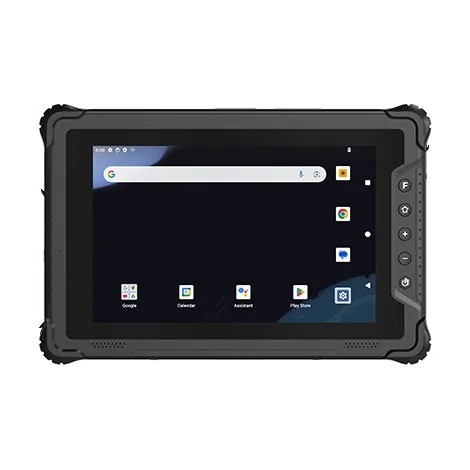
If long-range is the right answer, the H68T is the model we quote: an Android 14 handheld with a long-range 2D module specified to 10 m, IP68, and a battery sized for a full shift of scanning. Two practical notes from deployments:
- Long-range modules draw more power per read than standard engines. Budget battery capacity accordingly, and do not assume the runtime of a standard-engine unit applies.
- Aiming matters. Operators need a visible aiming pattern and a few minutes of practice; without it, first-week read rates look worse than they are.
What to send us
If you want a shortlist rather than a catalogue, send: the label height, the module size or a photo of the label, the aisle width, and whether the operator is standing or on a vehicle. With those four we can tell you whether a standard engine, a long-range module, or a different process is the right answer — and we will say so if it is the last one.