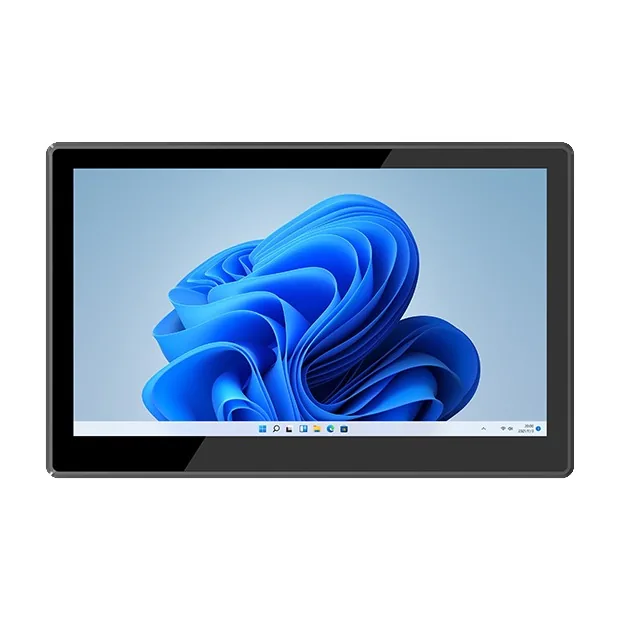
A tablet on a stand looks like the cheap answer for a workstation terminal. It is cheaper, it is quicker to deploy, and it is usually the wrong choice — not because tablets are bad, but because a production line is not a mobile environment. It is a fixed one where things get sprayed, bumped and left running for three shifts.
The reverse mistake is just as common: buying a panel PC for a task that genuinely moves, then discovering nobody can carry it.
The question that settles most of it
Ask one question: does the device need to move during a shift, or does the work come to the device?
If the work comes to the device — an operator at a station confirming steps, scanning incoming material, viewing a work instruction — it is a fixed installation and a panel PC is the right form factor. If the device travels with a person or a vehicle, it is a mobile device and a tablet or handheld is right.
Almost every bad line-side decision comes from answering this question wrong at specification time, usually because someone saw a tablet demo and liked the flexibility.
What a panel PC gives you that a tablet does not
Continuous duty. Fanless panel PCs are designed for 24/7 operation. Tablets are designed for a shift and a charge. Running a tablet continuously, docked, is the fastest way to age a battery.
A sealed front panel. IP65 front face on a fixed mount, with the enclosure protected behind it. A tablet's IP rating covers the whole device, but its ports and dock are the weak point — and on a line, the dock is where coolant and swarf get in.
No theft and no walking. A bolted panel does not end up in someone's bag. In plants where tools have a habit of migrating, this is not a minor point.
Wide voltage and wide temperature. Industrial power in a plant is not clean. Wide-voltage input with protection is standard on panel PCs and an afterthought on tablets.
Wired networking as standard. Gigabit Ethernet and serial ports on the device, without a dongle chain that fails at the worst moment.
What a tablet gives you that a panel PC does not
Portability, obviously, but also three less obvious things:
- Battery backup. A panel PC dies with the power. A tablet keeps the last transaction alive through a supply flicker.
- Faster changeover. Repurposing a line means unbolting a panel and re-mounting. A tablet moves in a hand.
- Lower entry cost per station. At ten stations, the difference is real money.
The TCO comparison buyers actually need
Nobody models this, and everybody should:
| Cost line | Panel PC | Tablet + dock |
|---|---|---|
| Unit + mount | Higher | Lower |
| Replacement cycle | 5–7 years | 2–3 years (battery ages first) |
| Downtime per failure | Low (fewer failures) | Higher (dock, battery, theft) |
| Losing a unit | Near zero | Real, and recurring |
| Per-station software licence | Same | Same |
The tablet's lower purchase price usually disappears by year three, and the downtime line is where the difference becomes visible. A single hour of stopped line output typically costs more than the hardware difference across the whole station.
If you cannot quantify the downtime cost, ask production for the number. They will have it.
The hybrid that often works
A practical pattern for mixed environments:
- Fixed stations: panel PC, 10–15 inch, IP65 front, wired Ethernet.
- Stations that occasionally move: tablet on a quick-release mount, with a charging dock at each home position.
- Roving quality and maintenance: handheld, not tablet. One hand free matters more than screen size.
This is not a compromise; it is how most mature plants end up after two or three iterations anyway. Starting there saves the iterations.
Specific models and where they fit
- P15A / P17J / P21A — fixed line-side and workstation terminals, 15–21 inch, IP65 front panel, fanless.
- P10J / P10A / D10R — compact workstations, kiosks, and station-level data capture at lower cost.
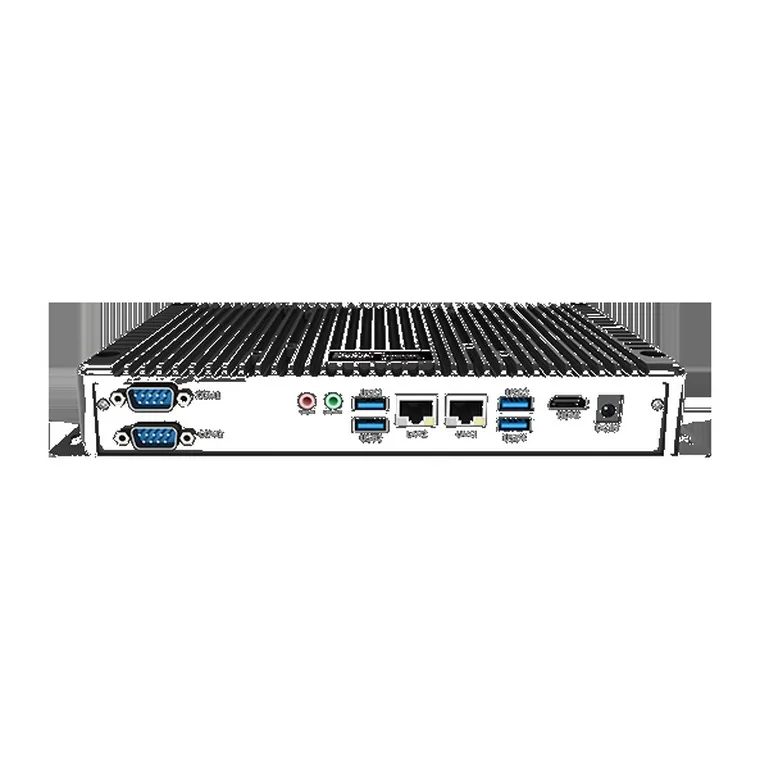
- B10A / B10J / B10R — box PCs for cabinet mounting: gateway, local WMS service, machine data collection. The B10A adds TPM 2.0, which regulated environments ask for.
- M10J / M17J — where the station genuinely moves, or where a Windows client needs a battery-backed device.
- M10L — where the station is also the inspection point and you want on-device inference rather than a cloud round-trip.
The decision in one line
If the device is bolted, powered and expected to last five years, buy a panel PC. If it moves with a person, buy a handheld or tablet. If it does both, buy both — the mixed fleet is cheaper than forcing one form factor to do two jobs, and it will be what you converge on regardless.
Tell us the number of stations, whether the client is Windows or browser-based, and what the plant's power quality is like. We will size the CPU and the enclosure rather than quote the whole range.