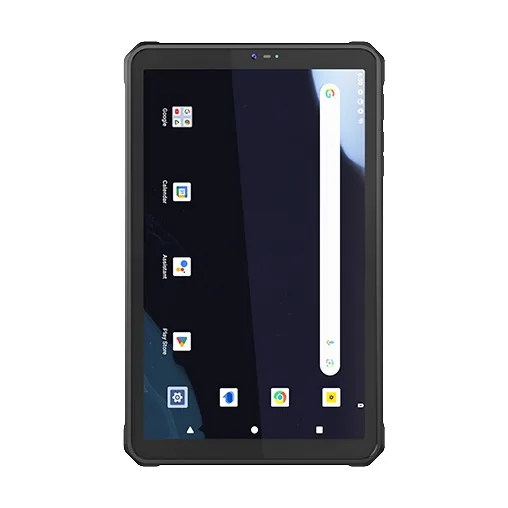
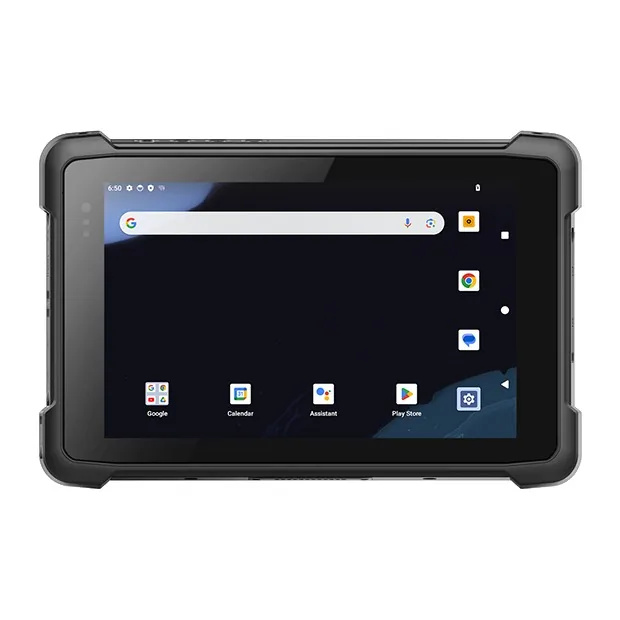
A fishing company buying its first batch of tablets usually starts with the same two filters: it has to be waterproof, and it has to be bright. Both are correct instincts. The problem is that the first filter is printed on the box in large letters, and the second one is not — so the market has converged on devices that pass the visible test and fail the one that actually ends the shift.
We have quoted into wheelhouses, processing decks and fish ports on three continents. The pattern is consistent enough to write down.
The number on the datasheet is not the number you need
Brightness is quoted in candelas per square metre, written as cd/m² or "nits". A mainstream consumer tablet sits around 400–500 nits. A rugged tablet sold for outdoor work usually claims 700. The devices marketed hardest as waterproof often sit at the bottom of that range:
| Device class | Typical brightness | Where it survives |
|---|---|---|
| Consumer tablet, IP68 claimed | 320–450 cd/m² | Cabin interior, shade, overcast |
| Rugged tablet, standard panel | 550–700 cd/m² | Wheelhouse, covered deck, early morning |
| Rugged tablet, high-bright panel | 1000 cd/m² | Open deck at midday |
At midday, direct sun plus white-painted deck and water reflection puts the ambient illuminance well above 80,000 lux. A 400-nit screen in that environment is a dark mirror: you can see that something is displayed, but not what. The crew's workaround is to turn their back to the sun, cup a hand over the screen, or walk into the shade — which defeats the purpose of a mobile terminal.
1000 cd/m² is the entry point for open-deck work, not a premium feature. Below that, the device is a cabin tool. This is not a matter of preference; it is arithmetic against ambient light.
Brightness alone is not enough either
Three properties decide readability together, and suppliers usually quote only the first:
Luminance — the 1000 cd/m² figure. Necessary, not sufficient.
Reflectance — how much of the sunlight bounces off the panel back at the eye. An anti-glare or AG-coated cover glass can make a 700-nit panel more readable than an untreated 1000-nit one in direct sun. If a supplier cannot tell you whether the cover glass is AG-treated, they have not tested it outdoors.
Contrast under glare — a glossy high-brightness screen still washes out because the reflected image of the sky sits on top of the content. This is why bonded displays with reduced internal reflection matter more on deck than in a warehouse.
The practical test is not a datasheet comparison. It is: take both units onto a deck at noon, open the same form, and try to read a nine-digit number without moving your feet. Fifteen seconds decides it.
The failure order on a real vessel
When a tablet fails at sea, it rarely fails in the order the specification suggests. In our experience the sequence is:
1. Nobody can read it. Costs nothing to fix, but it is discovered after purchase, and it is the reason the device ends up in a locker.
2. The battery cannot be swapped. A vessel's power is intermittent — generator hours, shore power in port, long trips where charging competes with other loads. A sealed device that needs three hours on a charger is a device that is unavailable for three hours. A removable pack that swaps in twenty seconds keeps the terminal in service across a shift. This single design decision matters more on a boat than IP rating, processor or screen size.
3. Water enters through the ports, not the shell. Housings are well sealed. The failure point is the USB cover left open, the DC jack with a corroded pin, the pogo connector with salt crystallised across it. IP65 means protected against water jets; IP67 means protected against temporary immersion. Neither rating covers a two-year-old rubber flap that no longer seats. Ask what the port covers are made of and whether they are replaceable.
4. Salt fog attacks connectors and fasteners before it attacks the case. Salt-laden air corrodes exposed metal: screws, port pins, docking contacts, speaker grilles. IEC 60068-2-52 is the salt-fog test that matters. Most rugged tablets are not tested to it, and most suppliers will not volunteer that. On a vessel, the difference shows up at month eight as an intermittent charging fault that nobody can reproduce in port.
5. The software cannot see the peripheral. The Bluetooth printer pairs but drops mid-trip; the scale connects over USB but the app expects serial; the RFID reader needs a driver that only exists for Android 11. This is discovered on the first trip, not in the demo, and it is the failure that makes a technically sound device unusable.
Notice that only one of these five is a hardware robustness question in the way buyers usually mean it.
What to actually specify
Replace "rugged and waterproof" with a short list that a supplier can be held to:
| Requirement | Target | Why |
|---|---|---|
| Panel brightness | ≥ 1000 cd/m² measured, not "optional" | Below this the device is cabin-only |
| Cover glass | Anti-glare treated | Decides readability more than raw nits in direct sun |
| Battery | Removable, hot-swappable, spares available | Determines uptime, not the IP number |
| Ingress protection | IP67 minimum if the device leaves the wheelhouse | IP65 is splash, not immersion |
| Salt fog | IEC 60068-2-52 declared, or written statement that it is not tested | The month-eight failure |
| Operating temperature | −20 °C to 60 °C minimum | Engine rooms and tropical decks in one trip |
| Port protection | Replaceable covers, gold-plated contacts | The actual water entry point |
| OS and GMS | Stated version, Google services present or absent | Decides which apps can be installed at all |
Two commercial notes that are not on any datasheet:
Buy the spare battery with the device, not later. A terminal with one pack is a terminal that is out of service for part of every day. The incremental cost is small against the cost of a crew waiting.
Ask for the accessory list before the price. Vehicle cradles, shoulder straps, pole mounts, hand straps and multi-bay chargers are what make a tablet survive a season. A device with no mounting ecosystem is a device that gets put down on a wet surface.
Where the multi-mode terminal fits
There is a second, separate decision on a commercial vessel: communication. A tablet solves the data workflow — catch registration, grading, cold-store counts, port handover. It does not solve voice beyond cellular coverage or position reporting to the fleet office.
On vessels working outside coastal LTE, that gap is filled by a multi-mode terminal: satellite voice and short message, digital radio for ship-to-ship and ship-to-shore, and AIS reception for traffic awareness. Where the satellite constellation covers the fishing grounds, this is a single device that replaces a satellite phone, a VHF handset and a separate position reporter. We treat it as a separate line item, because the frequency allocation and the airtime plan are country-specific and cannot be assumed.
The honest summary
A tablet for deck work is not a rugged tablet with a waterproof badge. It is a device with a 1000-nit anti-glare panel, a battery the crew can change with wet hands, IP67 sealing, replaceable port covers, and a mounting ecosystem that exists. Everything else — processor, camera, storage — is secondary on a boat, and most of the market is optimised for everything else.
If a supplier's answer to "can I read it on deck at noon" is a marketing sentence rather than a test you can run, that is the answer.